Our story · Our purpose
Good bread starts long before the oven.
I'm Danielle Cloud, the baker behind Knead It Bread Co. After my twins were born in February 2023, I wanted to feed my family something fresher and healthier. I started with one familiar pantry staple: bread. That curiosity became this bakery.
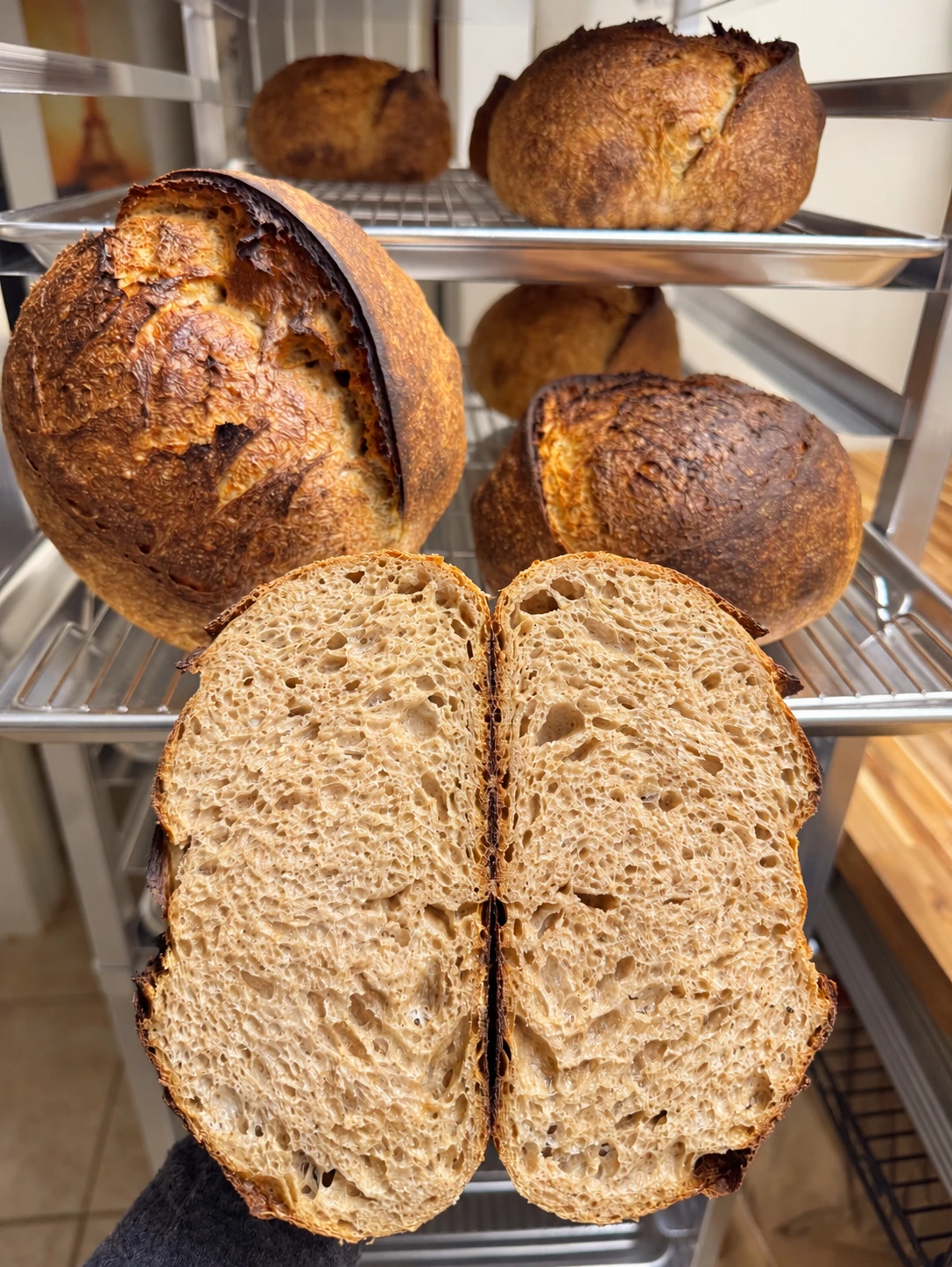
It started at our family table.
I dove headfirst into researching bread and fell in love with natural fermentation. Such simple ingredients, such an intricate process: watching a starter come to life, learning the feel of dough, and discovering how time changes a loaf. I wanted to understand it, then keep making it better.
The more I learned about fermentation, the more I wanted to understand the flour itself: what was in it, how it was made, and where the wheat began.
A closer look at everyday flour.
That curiosity changed how I read ingredient lists. I wanted to understand the choices behind a loaf, including the treatments used to make flour behave consistently in a commercial bakery. Something as familiar as white flour deserved a closer look.
Some commercial white flours sold in the United States and used in breads and other baked goods contain potassium bromate, an additive used to strengthen dough. It remains under FDA review, and California prohibits it in food beginning January 1, 2027.
For me, understanding those ingredients is part of choosing what goes on the family table. It also deepened my interest in working with grain from the beginning.
From wheat berry to fresh flour.
Today, that interest is part of our everyday work. I use a countertop Mockmill 200 to turn wheat berries into fresh flour. Its corundum-ceramic stones adjust from fine flour to coarse meal, and the manufacturer rates it at about 200 grams of wheat per minute — roughly seven ounces. It lets me work with grain a batch at a time, right here in the bakery.
A wheat kernel has three parts: bran, germ, and endosperm. Whole-grain flour keeps all three, bringing starch for energy along with protein, fiber, vitamins, and minerals. Refining white flour removes the bran and germ for a lighter texture and longer storage life, taking much of the fiber and some valuable nutrients with them.
Following the grain back to the soil.
Milling my own flour made me curious about the land behind it. That curiosity grew into an interest in regenerative farming and the care it gives to soil as a living system.
Practices such as rotating crops and keeping soil covered can help protect topsoil, support soil life, and improve how water moves through the ground. That is what draws me to this work: caring for the land that future harvests will depend on.
Supporting the next California harvest.
Buying California-grown wheat helps support the growers and the cleaning, storage, and milling that bring their harvest to our kitchens. A dependable market can help farmers plan for another season. That is a connection I want our bakery to strengthen: local bread supporting the next local harvest.
Farmers also need wheat that grows well here. The California Wheat Commission supports University of California research into wheat quality, yield, and disease resistance. Its milling and baking laboratory connects that work to the kitchen by testing how grain performs as flour and dough.
I care about the journey between those places, too. Knowing where grain is grown and milled helps us think more carefully about deliveries, unnecessary hauling, and the fuel used along the way. It brings the people behind our food closer to the table.
A grain community, here in Ukiah.
Here in Ukiah, local grain connects farms, shops, and kitchens. Mendocino Grain Project has helped build the regional grain economy since 2009, bringing farming, seed cleaning, milling, and distribution together. Like us, they use a stone mill, turning their grains into flour for local kitchens.
Ramen Cubed makes its noodles with Mendocino Grain Project heirloom wheat, and Ukiah Natural Foods Co-op carries the project’s products for home cooks. From a bowl of noodles to a loaf of bread, local grain has a place in the food our community shares.
Supporting that work helps keep growers connected to people who want their harvest. You can explore Mendocino Grain Project’s mission and shop its grains, flour, and dry goods through the links below.
From our family table to yours.
From our East Bay beginnings in 2023 to our home in the Ukiah Valley, the purpose of Knead It Bread Co. has stayed personal: feed our community real food, made with the same care that started at my own table.
What began with wanting better bread for my family has become something I am grateful to share with yours. Thank you for being here, for asking questions, and for supporting the people who grow, mill, and bake our food.
Danielle Cloud · Knead It Bread Co.
Sources & further reading
- 1.FDA flour standard · Potassium bromate in bromated flour
- 2.FDA · Food chemicals under review, including potassium bromate
- 3.California Governor's Office · AB 418 signing statement (PDF)
- 4.Mockmill · Model 200 stones, settings, and wheat output (manufacturer manual, page 22)
- 5.USDA Agricultural Research Service · Wheat: the Whole (Grain) Story
- 6.USDA Natural Resources Conservation Service · Living roots, crop diversity, and soil cover
- 7.University of California Agriculture and Natural Resources · Soil health science
- 8.Golden State Grains · Building California's grain community
- 9.California Wheat Commission · Wheat research and University of California partnerships
- 10.California Wheat Commission · Milling, baking, and grain-quality testing
- 11.Mendocino Grain Project · Story, mission, and farming work
- 12.Mendocino Grain Project · Stone-ground Sonora flour
- 13.Ramen Cubed · Handmade noodles with Mendocino Grain Project wheat
- 14.Mendocino Grain Project · Local retailers, including Ukiah Natural Foods Co-op
- 15.Mendocino Grain Project · Shop grains, flour, and dry goods